6 Common Wingfoil Mistakes in Fuerteventura (And Exactly How to Fix Them)
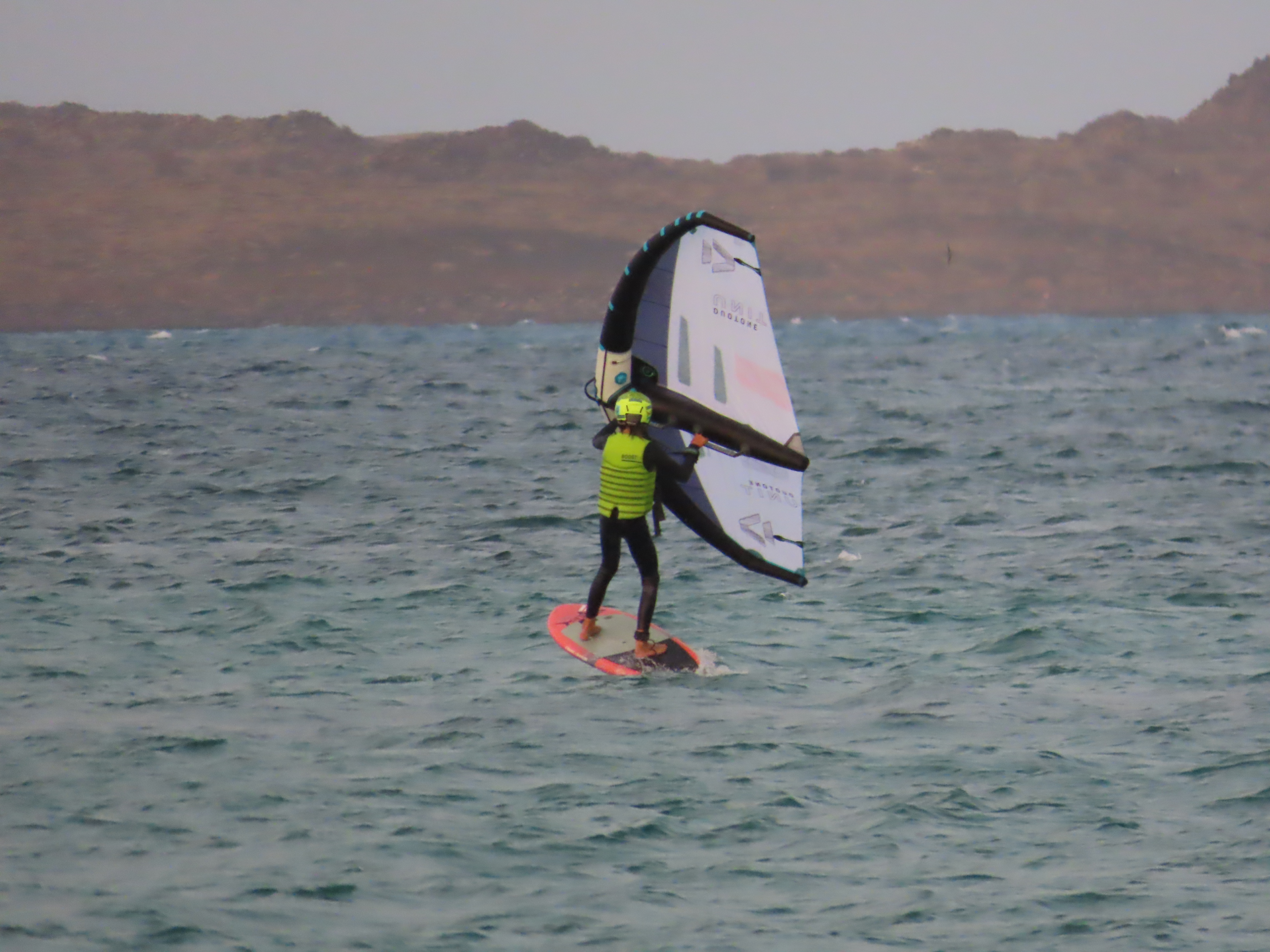
6 Common Wingfoil Mistakes in Fuerteventura (And Exactly How to Fix Them)
After teaching over 500 students at our wingfoil school in Corralejo, we have seen the same patterns emerge, session after session. Six mistakes appear so consistently that we now address them on Day 1, before anyone enters the water. The good news: every single one is avoidable if you know what to look for.
This guide draws directly from our coaching data at the Corralejo Lagoon, Flag Beach, and Majanicho — the three spots where we run all wingfoil lessons and camps.
---
Mistake 1: Starting in the Wrong Conditions
Corralejo is famous for its wind — which is precisely why beginners can get into trouble. In peak summer (June–August), wind regularly blows 22–28 knots at Flag Beach by early afternoon. That is expert territory, not beginner territory.
Most beginners need 12–18 knots and flat water to actually learn. In strong wind, you spend 80% of your energy fighting the wing and recovering from falls instead of building technique.
Corralejo Spot Guide for Beginners:
| Spot | Wind Range | Water | Best For | |------|-----------|-------|----------| | Corralejo Lagoon | 12–20 knots | Flat | Complete beginners, foil learning | | Waikiki / Kite Beach | 15–22 knots | Small chop | Early intermediate | | Flag Beach | 18–28 knots | Choppy | Intermediate to advanced | | Majanicho | 20–30 knots | Flat water, strong wind | Advanced only |
Our instructors check wind conditions every morning and select the right spot for each group. This decision alone can cut a beginner's learning time in half.
---
Mistake 2: Using Equipment That Is Too Advanced
Many beginners arrive in Corralejo having bought gear they saw on Instagram — compact wings, high-performance foils, short boards. These are race tools. They are not learning tools.
Equipment guide by level:
| Level | Wing Size | Board Volume | Foil Front Wing | |-------|----------|-------------|----------------| | Complete beginner | 5–6 m² | 130–160L | 1800–2200 cm² | | Early intermediate | 4–5 m² | 100–130L | 1500–1800 cm² | | Intermediate | 3–5 m² | 80–110L | 1200–1600 cm² | | Advanced | 2–4 m² | 60–90L | 800–1400 cm² |
More volume means more stability. A bigger front wing means earlier, smoother lift. Both mean faster learning. Our wingfoil lessons include all Armstrong equipment matched to your exact level — no guessing, no extra cost.
---
Mistake 3: Trying to Learn Alone
Wingfoil looks straightforward on video. In reality, learning without a qualified instructor is significantly slower and carries real safety risks.
Our internal coaching data shows a clear pattern: students who take structured lessons with radio communication in the water reach their first foil flights in 4–6 sessions on average. Students who try to self-teach in Corralejo typically need 15–25 sessions to reach the same point — if they get there at all.
What a certified instructor gives you: - Real-time corrections via waterproof radio (you hear the fix while you are on the board) - Video analysis after each session - A structured progression that avoids the bad habits that self-taught students develop - Safety supervision — the foil is a sharp piece of equipment that requires proper awareness from Day 1
👉 If you are deciding between lessons or renting gear independently, read our beginner wingfoil guide for Fuerteventura to understand the full picture.
---
Mistake 4: Skipping Land Practice
Every session at our school starts on the beach, not in the water. This surprises many students — but never after the first 20 minutes.
Wing control is 70–80% of wingfoil. If you cannot hold the wing neutral, generate power smoothly, and change hands without hesitation on land, the water will be chaos. Our standard land session before every beginner lesson covers:
- Neutral window: holding the wing overhead with zero pull, walking forward - Power and depower: generating thrust and dumping it on command, 10 repetitions - Hand transitions: swapping your grip fluidly during a simulated gybe - Correct hand position: arms at a 20–30° bend, never locked straight (causes arm fatigue and loss of feel)
30–45 minutes on land translates directly into smoother, more confident first sessions on the water.
---
Mistake 5: Standing Too Early
The urge to stand up and ride on Session 1 is completely understandable. It is also the reason many beginners develop unstable habits that take weeks to unlearn.
Our step-by-step protocol at the Corralejo Lagoon:
1. Body drag: in the water, wing only — no board. You learn to feel wind power without the complexity of balance. 2. Kneeling on board: board and wing together, still on knees. Find your balance point, practise steering. 3. Back foot first: rise to one knee, then place the back foot. Pause here until stable. 4. Full stance: front foot forward only when back foot is completely stable.
Students who follow this sequence consistently stand and ride in Session 2. Students who skip to standing immediately on Session 1 often still struggle to ride clean by Session 5.
---
Mistake 6: Not Understanding Local Wind Patterns
Fuerteventura's wind is not uniform — it varies significantly by time of day, month, and location. Not understanding this means sessions in the wrong place at the wrong time.
Corralejo wind patterns beginners should know:
- Morning (8–11am): wind is lighter, 10–16 knots. Best for beginners. Lagoon is smooth. - Midday (11am–2pm): wind builds rapidly. Flag Beach becomes active, lagoon stays manageable. - Afternoon (2–6pm): peak wind, 22–30 knots. Expert conditions at most spots. Lagoon may still be viable. - June–August: Corralejo's busiest wind months. Consistent thermal wind daily from the northeast. - November–February: lighter, more variable. Still rideable, but some days are non-wind.
Our wingfoil camp sessions are timed to match optimal learning windows, not just weather forecasts.
---
Mistakes vs. Best Practices at a Glance
| Mistake | What Happens | Correct Approach | Time Saved | |---------|-------------|-----------------|-----------| | Wrong conditions (25+ knots) | Energy wasted fighting the wing | Start at 12–18 knots, lagoon | 2–4 sessions | | Advanced gear | No stability, no feel | Beginner-sized board and wing | 3–6 sessions | | Learning alone | Slow feedback loop, bad habits | Certified instructor + radio | 10–15 sessions | | Skipping land practice | Chaotic first water sessions | 30–45 min beach session first | 1–2 sessions | | Standing too early | Unstable habits locked in | Follow the 4-step progression | 2–4 sessions | | Wrong spot/time | Fighting conditions instead of learning | Lagoon, morning session | 1–3 sessions |
---
Frequently Asked Questions
Is wingfoil hard to learn if I have no board sport experience? No prior experience is required. At our Corralejo school, some of our fastest-progressing students had never stood on a surfboard, kiteboard, or windsurf board. Wingfoil technique is learnable from scratch — in some ways it is easier than teaching an experienced kiter or surfer who has pre-existing habits to undo. Most complete beginners get their first foil flights in sessions 4–6 with structured instruction.
How long does it realistically take to learn wingfoil in Fuerteventura? With a certified instructor, most students reach their first foil flights in 4–6 sessions (2–3 hours per session). A full 7-day wing foil camp typically brings students to consistent, controlled foiling in both directions — a milestone that can take months of weekend lessons to reach. Fuerteventura's consistent northeast wind means you can progress every single day, unlike spots where you wait weeks for the right conditions.
What equipment is provided in lessons and camps? All lessons and camps at Fuerteventura Wing Foil include Armstrong wings (4–6 m² depending on your weight and level), foil-specific boards (130–160L for beginners), Armstrong hydrofoils, 3mm full wetsuit, helmet, and impact vest. Nothing is charged separately. You bring yourself — we bring everything else.
What makes Corralejo Lagoon the best place to learn wingfoil? The Corralejo Lagoon (inside the Corralejo Natural Park) offers flat, knee-to-waist-deep water with consistent thermal wind — a combination that is genuinely rare in the world. There are no rocks, no waves, no boat traffic, and the shallow depth means falls are low-consequence. It is one of the most forgiving learning environments in Europe for water sports, which is why we use it for all beginner and early intermediate sessions.
---
The Fastest Path to Your First Foil Flight
Avoiding these six mistakes is the most direct route to enjoying wingfoil — instead of just struggling with it. Every hour you spend fighting wrong conditions, wrong gear, or bad habits is an hour you could spend actually flying.
Our instructors in Corralejo are trained to catch and correct all six of these mistakes in real time. Radio communication in the water means you hear the correction the moment it's needed — not at the end of the session when the moment has passed.
👉 Group lessons from 90€ per person | Private lessons from 120€ | Camps from 116€/night | All equipment included
Book your wingfoil lesson in Corralejo → Corralejo wingfoil spots: where we teach → See our Corralejo spot guide and local wind tips → Complete beginner guide: when to come and what to expect →
Ready to learn wingfoil in Fuerteventura?
Take advantage of perfect conditions in Corralejo and learn with certified instructors.
Book your wing foil lesson in Fuerteventura →