Wingfoil Corralejo – The Best Spot in the Canary Islands
Corralejo, in the north of Fuerteventura, is widely considered the best wingfoil destination in the Canary Islands and one of the top three in all of Europe. A combination of consistent NE trade winds, a protected shallow lagoon, and multiple spots for all skill levels makes it the perfect place to learn wingfoil or push your riding to the next level.
Our wingfoil school in Corralejo offers group lessons 120€ per person for 2 hours, with a maximum of 2 students per instructor, and private lessons 150€ for 2 hours, with 1 student and 1 instructor. Surf house camps start at 136 €/day with a wing foil lesson included.
Best Wingfoil Spots in Corralejo
| Spot | Water | Wind | Best for |
|---|---|---|---|
| Corralejo Lagoon | Depends on tide, wind and launch | N preferred; NE–E technical | Assessed by level and conditions |
| Flag Beach | Chop, some swell | 15–25 kn (NE) | Intermediate riders |
| Waikiki Beach | N usually offers less chop | Assess actual conditions | NE–E requires technical skills |
| El Burro / Majanicho | Swell, open ocean | 20–30 kn | Advanced riders |
Wind Conditions in Corralejo
We choose a spot according to rider level, tide, rocks and shallows, actual wind, chop and possible turbulence or wind shadows. More knots do not automatically mean a better lesson. A beach or session cannot be guaranteed.
| Month | Avg Wind | Wind Days/Month | Recommendation |
|---|---|---|---|
| April | 12–18 kn | 18–22 days | Great for beginners |
| May | 15–22 kn | 22–25 days | All levels |
| June | 18–26 kn | 24–28 days | Best month overall |
| July | 20–28 kn | 26–30 days | Strongest wind |
| August | 20–28 kn | 26–30 days | Strongest wind |
| September | 15–22 kn | 20–24 days | Warm water, good wind |
Why Choose Our Wingfoil School in Corralejo?
- 🏄 500+ students taught since 2016
- 🎓 Certified VDWS & IKO instructors – multilingual (ES, EN, DE, FR, IT)
- 🪁 Latest Armstrong foil gear – wings, boards, foils all included
- 📍 Multiple spots – we select the best one based on daily conditions
- 🏠 Surf house camp in Corralejo from 136 €/day with a wing foil lesson included
Frequently Asked Questions – Wingfoil Corralejo
Is Corralejo good for wingfoil beginners?
North (N) is our preferred direction at Waikiki, in front of Waikiki Beach Club. It usually offers more comfortable riding, less chop and sometimes especially flat water. That does not guarantee beginner suitability. At Waikiki, NE–E wind is predominantly onshore at the launch sector we use. Getting out can be technical: good upwind ability, tacks and jibes are needed to link zigzag reaches towards a more comfortable riding area. Low and mid tide expose rocks and shallows along the route; more chop can develop. Stronger or steadier wind does not make this a beginner launch.
How far is the wingfoil spot from Corralejo town centre?
The Corralejo Lagoon and Flag Beach are 5–10 minutes by car from the town centre. We provide transport from the meeting point to the best spot of the day, included in all lessons and camps.
Can I wingfoil in Corralejo in winter?
Yes, Corralejo has wind year-round. Winter months (November–March) are windier but conditions are more variable and the water is cooler (17–19°C). For best learning conditions, we recommend April to September.
What other water sports can I do in Corralejo?
Corralejo is also famous for kitesurfing, windsurfing, surfing, and SUP. Many visitors combine wingfoil lessons with other activities. The town has rental shops, restaurants, and a lively social scene for water sports lovers.
Corralejo vs Other Wingfoil Destinations in Europe
Every year, thousands of wingfoilers choose between different European destinations. Here is an honest comparison based on 8 years of experience and our students' feedback:
| Destination | Wind Consistency | Flat Water | Water Temp | Best For |
|---|---|---|---|---|
| Corralejo, Fuerteventura | Daily (Apr–Sep) | ✅ Lagoon (1–2m) | 20–25°C | All levels, especially beginners |
| Tarifa, Spain | Good, but gusty | ⚠️ Limited flat water | 16–20°C | Intermediate to advanced |
| El Médano, Tenerife | Consistent | ⚠️ Some chop | 20–23°C | All levels |
| Pozo, Gran Canaria | Strong wind | ❌ Waves | 20–24°C | Advanced, wave riders |
| Lanzarote | Variable | ⚠️ Limited | 19–23°C | Intermediate |
| Rhodes / Greece | Seasonal Meltemi | ⚠️ Chop | 24–26°C | Intermediate, seasonal |
The verdict: Corralejo's combination of a protected flat-water lagoon, daily trade wind, warm water year-round, and quality instruction infrastructure makes it the clearest choice in Europe for anyone learning wingfoil from zero or progressing from early intermediate.
Book Your Wingfoil Lesson in Corralejo
Group: 120€ per person, 2 hours, maximum 2 students per instructor · Private: 150€, 2 hours, 1 student and 1 instructor
Book NowA Local Instructor's Guide to Using Corralejo's Spots
After 8 years of daily sessions in Corralejo, our instructors have developed a clear protocol for spot selection. Here is the real knowledge — the kind that takes years to learn:
The 09:30 Rule at the Lagoon. In peak season (June–August), the Corralejo Lagoon is best before 10am. After that, the increasing thermal wind creates chop inside the lagoon and the space fills up with kite and wing foil students. We always aim to be in the water by 09:30 for beginner sessions — smooth water, building wind, maximum space.
When we choose Flag Beach over the Lagoon. On days with 18–22 knots and side-shore NE, Flag Beach offers the best progression for intermediate students. The small beach break waves teach you to handle variable conditions. We never send beginners there on their first 1–2 sessions, but it becomes the training ground from Session 3 onwards for faster learners.
Majanicho: the best-kept secret. This spot 15 km north of Corralejo (inside the Natural Park) offers pancake-flat water with 24–32 knot wind. It is what we use for advanced students who want to practise freestyle, big-air, or wing-in-hand without ocean swell interference. Most tourists never visit it — which is exactly why we love it.
The "panza de burro" cloud. In summer, a layer of stratus cloud sometimes sits over Corralejo in the morning, blocking the sun and slowing the thermal buildup. On these days, the wind arrives 1–2 hours later than usual (11am instead of 9am). Our instructors check the sky at dawn — if the cloud is thick, we delay the session start to catch the best window. Self-taught students who book without guidance often miss this.
For a complete breakdown of monthly wind data, daily patterns, and forecast tools, see our detailed Wind Conditions in Corralejo guide. And if you are just starting, our beginner wingfoil page covers everything you need before your first session.
Book your wingfoil lesson in Corralejo
Choose group or private instruction in Corralejo, or ask about surf house camps from 136 €/day with a wing foil lesson included.
Book a Lesson in CorralejoCorralejo Wingfoil Wind Map: Waikiki, Sunset & Las Agujas
Understand how wind direction, tides and local conditions affect each beach before choosing where to ride.
Illustrative maps only. Embedded coordinates, scale and distances are indicative, unverified and pending cartographic validation. These are not navigation charts. Do not use them to navigate or choose an entry point.
The labels inside both images are in Spanish; the explanations below are in English.
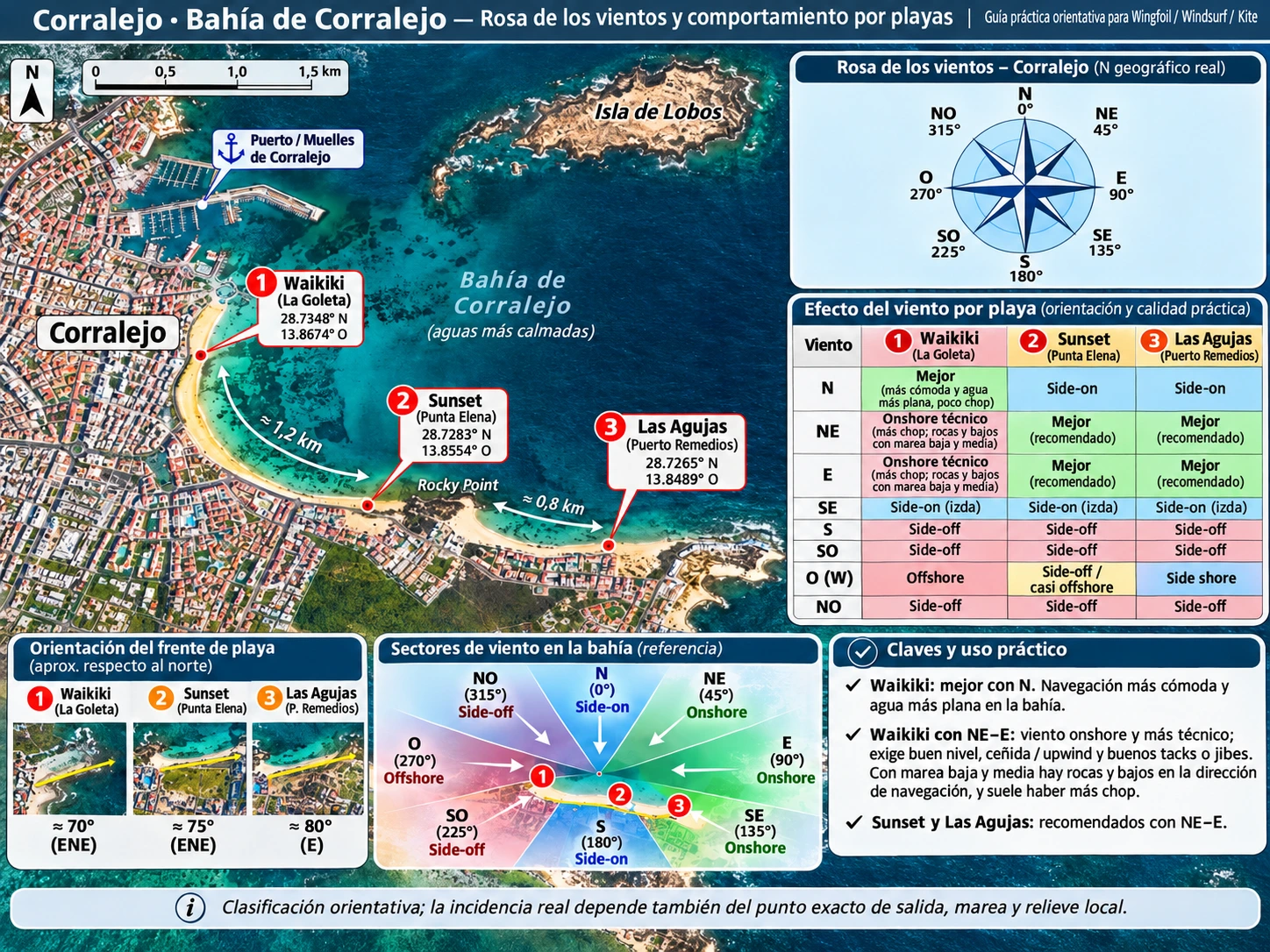
Unresolved discrepancy in map 1: the wind-sector inset labels south (S) as side-on, while the per-beach table labels it side-off. Do not use this classification until it has been verified. The supplied image has not been corrected.
Waikiki: why north wind works best
North (N) is our preferred direction at Waikiki, in front of Waikiki Beach Club. It usually offers more comfortable riding, less chop and sometimes especially flat water. That does not guarantee beginner suitability.
Waikiki with NE–E: upwind skills, chop and shallow rocks
At Waikiki, NE–E wind is predominantly onshore at the launch sector we use. Getting out can be technical: good upwind ability, tacks and jibes are needed to link zigzag reaches towards a more comfortable riding area. Low and mid tide expose rocks and shallows along the route; more chop can develop. Stronger or steadier wind does not make this a beginner launch.
Sunset: an alternative for NE–E wind
With NE–E, Sunset, in front of Sunset Lounge / Punta Elena, can be preferable to Waikiki. Its local shoreline and launch orientation differ, so the approach is not the same as Waikiki's onshore exit. Our instructors assess the actual wind, tide, water and rider level; no rock-free entry or guaranteed session is implied.
Las Agujas: wind angle and sailing conditions
Las Agujas, in the Puerto Remedios sector, can also be preferable with NE–E, depending on level and conditions. A west (W) wind that is offshore at Waikiki can be side-shore at Las Agujas. Assess each beach and the exact launch separately.
Understanding side-shore, onshore and offshore wind
Onshore blows towards the beach; offshore blows away from it; side-shore runs along it. These terms depend on the local shore and exact launch, not the bay as a whole. Wind quality is not the same as ease of launch, water quality or safety.
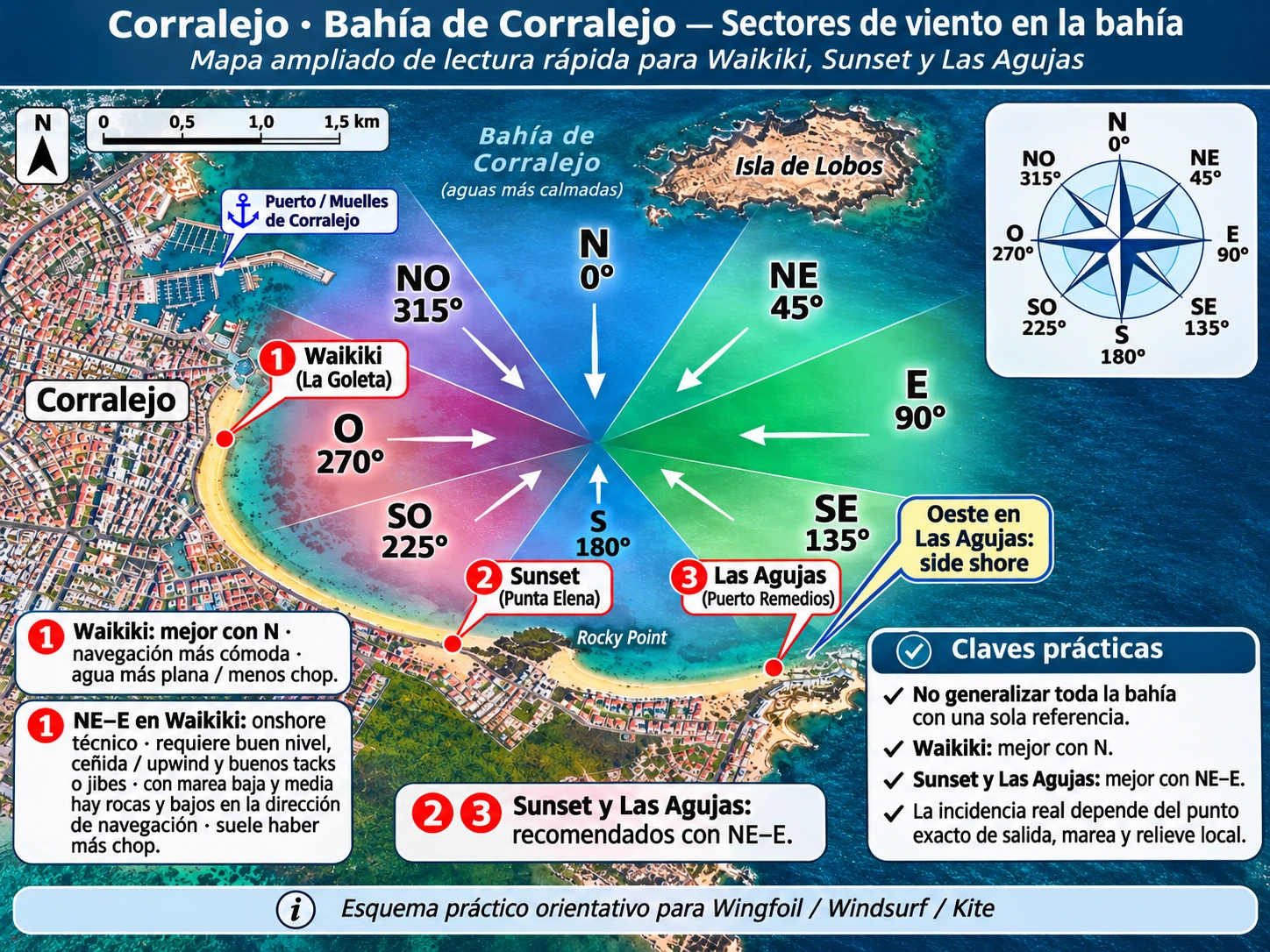
Explanations edited by Fuerteventura Wing Foil School. This editorial credit does not claim authorship of the imagery or cartography.
We choose a spot according to rider level, tide, rocks and shallows, actual wind, chop and possible turbulence or wind shadows. More knots do not automatically mean a better lesson. A beach or session cannot be guaranteed.
Corralejo wind maps: six local answers
What is the best wind direction for wingfoiling at Waikiki Corralejo?
North is the preferred direction at Waikiki: generally more comfortable riding and less chop, sometimes particularly flat water. Always assess tide, actual wind and rider level.
Is northeast wind good for beginners at Waikiki?
Not automatically. NE–E is predominantly onshore at the launch used at Waikiki. It can require good upwind skills, tacks and jibes, with chop and rocks at low or mid tide. Do not choose it for a beginner just because the wind is stronger.
Where should I wingfoil in Corralejo with east wind?
Sunset and Las Agujas can be preferable alternatives to Waikiki with east wind. The choice depends on your experience, tide, actual wind, water conditions and the precise launch.
Is Las Agujas better than Waikiki with NE wind?
Las Agujas can be preferable with NE wind, as can Sunset. This is not a guarantee of an easy launch or beginner suitability: an instructor must assess the day's conditions and your level.
Why can offshore wind at Waikiki be side-shore at Las Agujas?
The local shoreline changes orientation. West wind can blow away from Waikiki but along the shore at Las Agujas. One wind classification cannot describe the entire bay.
How does the tide affect wingfoiling at Waikiki?
At low and mid tide, rocks and shallows affect the sailing route at Waikiki, especially during technical NE–E exits. Check actual depth and conditions locally; these illustrative maps are not navigation charts.
Not sure which Corralejo beach is right for your level?
We choose the most suitable available spot based on wind direction, tides, water conditions and your wingfoil experience. Tell us your level and preferred dates, and we'll help you plan your session.
Book a Wingfoil Lesson · Ask Us on WhatsApp · Explore Our Wingfoil Classes