How to start wingfoil from scratch: complete guide for beginners
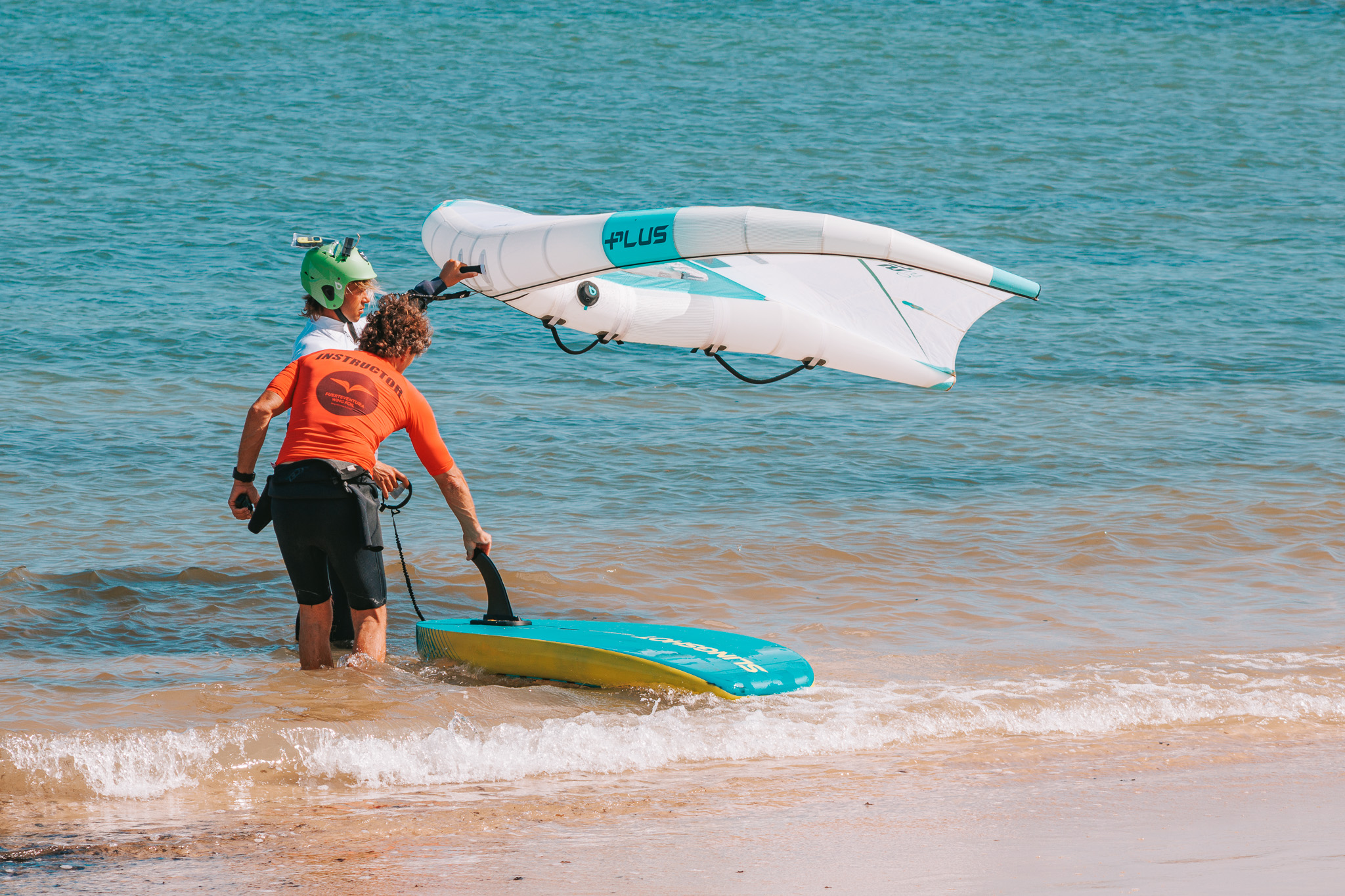
Wingfoil has become one of the most popular water sports in the world. Its mix of freedom, wind and the incredible sensation of "flying" over the water makes it an addictive experience. If you've ever thought about getting started but don't know where to begin, this guide is for you.
In this article we explain everything you need to know to start wingfoiling from scratch: equipment, technique, common mistakes, how to progress, and why learning with professionals is key.
🎯 What is wingfoil and why is it so popular
Wingfoil combines a board with a foil (an underwater wing that lifts with speed) and an inflatable wing that you hold with your hands. Unlike kitesurfing or windsurfing:
- There are no lines - The equipment is lighter - It's safer - Learning is faster - It can be practiced in light wind and open spaces
The result is an accessible, fun sport suitable for any age.
🧩 What you need to start wingfoiling
If you're starting out, this is what you need to know about equipment:
1. The wing
This gives you power. For beginners, a size between 4 and 5 m² is recommended, depending on your weight and wind strength.
Tip: start with constant, moderate wind (14–20 knots).
2. The board
For beginners, a large, stable board with lots of volume is ideal.
- Recommended volume: your weight + 30 to 40 liters. - Example: if you weigh 70 kg → 100–120 L board.
3. The foil
This is the piece that will lift you above the water.
- Mast: 70–85 cm - Front wing: large (1800–2200 cm²) for easy lift - Material: aluminum to start (more economical and resistant)
4. Leash and safety equipment
- Board leash - Wing leash - Impact vest - Helmet (recommended) - Wetsuit according to temperature
🌊 First steps: how to progress faster
Here's an effective step-by-step progression:
1. Practice on land
Before entering the water, learn to hold the wing.
- How to position your hands - How to orient the wing according to wind - How to generate and cut power
This greatly accelerates learning.
2. Start on a large board without foil (optional but very useful)
Some schools use a large SUP board to teach you to handle the wing without worrying about foil balance.
You'll learn to:
- Get up - Navigate downwind - Change direction
3. Add the foil when you control the wing
This is the most exciting moment. Start in an area without waves and with stable wind.
Initial goals:
- Maintain speed - Lift the board slightly - Control height without "shooting off" - Navigate in a straight line
4. Learn your first maneuvers
Once you control the basics:
- Direction changes - Sailing upwind - Starting without sinking - First transitions
From here, progression speeds up fast!
🚫 Common mistakes to avoid when starting
These are the most typical beginner mistakes:
- Wanting to use small equipment from day one (makes everything harder). - Extending arms too much, losing wing control. - Looking at the foil instead of looking forward. - Trying alone, without instruction (takes much longer). - Choosing days with too strong wind.
Avoiding these mistakes will make you progress 3 times faster.
🏄♂️ How long does it take to learn wingfoil
With good conditions and a professional instructor:
- Day 1: basic wing control - Day 2–3: stable navigation - Day 4–5: your first foil flights - 1 week: navigating in both directions with control
The learning curve is surprisingly fast compared to other wind sports.
🌴 Why learning at a school is the best decision
Although it's possible to try learning on your own, doing it with professionals has great advantages:
- Appropriate equipment for each stage - Immediate error correction - Greater safety - Faster progression - Known spot conditions - Motivation and structure
A good school can reduce learning time from months to days.
🔥 Conclusion: everyone can start wingfoiling
Wingfoil is an accessible, safe and extremely fun sport. Starting from scratch is easier than it seems if you have the right equipment, good conditions and expert instructor guidance.
If you're looking for a sport that connects you with the sea, that makes you improve every day and gives you unique sensations of freedom, wingfoil is your next adventure.
---
Wingfoil Progression Timeline: From Zero to Autonomous
| Sessions | What You Learn | Milestone | |----------|---------------|----------| | 1–2 | Wing control on land and water, body dragging | Comfortable in the water | | 3–4 | Board riding without foil, steering with wing | Riding across the wind | | 5–7 | Foil introduction, first lifts | First foil flights! | | 8–12 | Height control, both directions | Consistent foiling | | 13–20 | Gybes, tacks, upwind | Full autonomy | | 20+ | Tricks, jumps, waves | Advanced riding |
In our wingfoil camps in Fuerteventura, 7 consecutive daily sessions take most beginners from zero to consistent foiling — a result that would take 2–3 months of weekend sessions elsewhere.
---
Frequently Asked Questions: Starting Wingfoil from Scratch
Do I need any water sports experience to learn wingfoil? No. Wingfoil is a standalone sport that does not require prior surfing, kitesurfing, or windsurfing experience. Clean technique is easier to build from scratch than to unlearn from another sport. All you need is basic swimming ability and reasonable fitness.
How many sessions do I need before my first foil flight? Most complete beginners at our Corralejo school get their first sustained foil flights in sessions 4–6. Those with good body awareness or board sports background sometimes get them in session 3.
What is the best spot for a beginner to learn wingfoil in Corralejo? The Corralejo Lagoon is ideal: flat water, 1–2m depth, protected from swell, consistent 12–20 knot side-onshore wind. We use this spot for all beginner lessons. As you progress, we move to Flag Beach and Waikiki for more variety.
How much does a beginner wingfoil course cost in Fuerteventura? Group lessons start from 90€ per person (2 hours, maximum 3 students per instructor). Private lessons start from 120€ (2 hours, 1 student and 1 instructor). All equipment is included. A full week-long camp with accommodation and daily sessions starts from 116€/night.
---
How to Choose a Wingfoil School: Green Flags and Red Flags
Not all wingfoil schools are equal. In Corralejo alone, there are several operators. Here is what to look for before booking:
Green flags (what a good school does): - Certified instructors (VDWS, IKO, or equivalent national certification) - Radio communication in the water, not just shouting from shore - Equipment matched to your level — not one board and wing size for all students - Spot selection based on daily conditions (they check the forecast every morning) - Video analysis after sessions so you can see your own technique - Maximum 3 students per instructor in group lessons - Clear policy if wind fails or conditions are unsafe
Red flags (walk away): - No certifications when asked - "Rent the gear and we'll watch from the beach" - One wing size for all beginners regardless of weight - Groups of 6-8 students per instructor - No radio communication in the water
---
Your First 30 Days: A Realistic Progression Plan
If you are planning a wingfoil trip, here is what a realistic first month looks like from zero:
| Period | Format | Focus | Expected Outcome | |--------|--------|-------|------------------| | Days 1-7 (Camp week) | Camp in Corralejo | Wing, board, foil introduction | First foil flights by Day 4-5 | | Weeks 2-4 (if at home) | Local practice or return | Consolidation, consistency | Riding in both directions | | Month 2 | Any consistent wind spot | Upwind, gybing, height control | Basic autonomy |
The honest truth about Month 2: Most students do their camp, feel confident flying, return home, and then find it hard to ride again because they cannot find suitable conditions. The skill plateau during a 3-4 week gap is real. If possible, book a second short trip to Corralejo in Month 2 for 3-4 more sessions to cement what the camp built.
---
Equipment: Buy, Rent, or Borrow?
In your first 5-10 sessions: rent everything. Your instructors provide the right gear for your level and conditions. You do not yet know what wing size, board volume, or foil feel suits you.
When to consider buying (sessions 10-20): Once you know the wing size you ride most often (probably 5m if 70-85 kg), the board volume you need (still large: 110-130L), and that you will actually keep riding.
Budget guide for a complete beginner setup (second-hand):
| Item | Second-hand | New | |------|-------------|-----| | Beginner wing (5-6m2) | 300-500 euros | 700-1200 euros | | Foil board (120-150L) | 400-800 euros | 1200-2000 euros | | Hydrofoil (complete) | 500-1000 euros | 1500-3000 euros | | Wetsuit and safety gear | 100-200 euros | 300-600 euros |
For a first trip to Fuerteventura: bring nothing except your enthusiasm. Rent through us. After your camp, you will make a much better purchase decision. See our complete beginner guide and Corralejo spot overview for everything you need to plan your first trip.
---
Start Your Wingfoil Journey in Corralejo
At Fuerteventura Wing Foil we have taught 500+ students from scratch in Corralejo. Our structured progression method, world-class conditions, and certified instructors make it the fastest and safest way to learn wingfoil in Europe.
Group lessons from 90€ per person | Private lessons from 120€ | Camps from 116€/night | All equipment included
👉 Book your first wingfoil lesson in Fuerteventura →
Also read: 5 common wingfoil mistakes and how to avoid them | Wingfoil for beginners guide
Ready to learn wingfoil in Fuerteventura?
Take advantage of perfect conditions in Corralejo and learn with certified instructors.
Book your wing foil lesson in Fuerteventura →